What's Actually Causing Your Back Pain?

Low back pain sidelines more adults from work and activity than any other condition. But "low back pain" is a symptom, not a diagnosis. Your pain signals that something specific in your spine needs attention, and identifying that something is the key to getting you back to your game.

Common causes for active adults:

  • Repetitive loading without adequate recovery from weekly training, golf, or running
  • Prolonged sitting followed by sudden demand (desk all day, then intense workout)
  • Compensation patterns when hips lack mobility or core stabilizers fire too slowly
  • Deconditioning after time away from training

The evidence is clear: Early intervention (within 14 days of onset) leads to significantly better outcomes and lower risk of chronic pain. (Fritz et al., 2012)

Types of Low Back Pain

Disc-Related Pain (Bulges and Herniations)

Your spinal discs act as shock absorbers with a gel-like center surrounded by tough outer rings. When stress causes the inner gel to push against or through those outer layers, you get a bulging or herniated disc.

Feels like Deep central ache + leg pain (often below the knee), may include numbness or tingling
Worse with Sitting, bending forward, coughing, sneezing
Better with Standing, walking, lying face-down
Key insight If leg pain retreats toward your spine with certain movements (centralization), that's a positive prognostic sign (Long et al., 2004)
Recovery outlook: 80-90% of disc herniations resolve without surgery. Your body can actually resorb herniated disc material over time. (Zhong et al., 2017)


Spinal Stenosis

Stenosis occurs when the space inside your spinal canal narrows over time due to disc changes, ligament thickening, and bone spur development. This compresses the nerves.

Feels like Leg heaviness, cramping, or fatigue with walking (often both legs)
Worse with Standing upright, walking distances, lying flat
Better with Sitting, leaning forward (the "shopping cart sign"), cycling
Key insight You can walk a certain distance before needing to stop, but sitting or leaning forward provides quick relief
Who it affects: Most common in adults over 60. (Lurie & Tomkins-Lane, 2016)

Facet Joint Pain

Your facet joints are paired joints at the back of each spinal segment. Like any joint, they can become stiff, inflamed, or arthritic.

Feels like One-sided, deep ache near the spine; may spread to buttock or thigh (rarely below knee)
Worse with Arching backward, rotating (like a golf follow-through)
Better with Gentle movement, flexion-based positions
Key insight Morning stiffness that improves once you get moving is common

SI Joint Dysfunction

Your sacroiliac (SI) joints connect your spine to your pelvis. When they become too stiff or too loose, they generate pain. Common in women post-pregnancy and people with asymmetrical movement patterns.

Feels like One-sided pain right over the bony prominence at your pelvis (PSIS); may spread to groin or outer hip
Worse with Getting out of a car, climbing stairs, single-leg stance
Better with Walking at comfortable pace, avoiding asymmetric loading
Key insight You can usually point to the exact spot with one finger

Spondylolisthesis (Vertebral Slippage)

Spondylolisthesis means one vertebra has slipped forward relative to the one below. In younger athletes, this typically results from a stress fracture. In older adults, degenerative changes allow slippage without fracture.

Feels like Sensation of instability or a "catch" when moving from bent to upright; low back and buttock pain
Worse with Standing, walking, extension activities
Better with Sitting, flexion-based positions
Key insight Tight hamstrings are almost universal as your body's protective response

Quick Comparison: Identifying Your Type

Feature Disc Herniation Stenosis Facet Joint SI Joint
Typical age 30-50 60+ 50+ Any (common post-pregnancy)
Pain location Back + leg (below knee) Both legs, diffuse One-sided, near spine One-sided, over PSIS
Worse with Sitting, bending forward Standing, walking Arching, rotating Stairs, single-leg activities
Better with Standing, walking Sitting, leaning forward Movement Even walking
Classification Flexion-intolerant Extension-intolerant Extension-intolerant Load transfer issue

How We Diagnose and Treat Low Back Pain

Our Assessment Process

Your story tells us more than any scan. We identify your specific condition through:

  • Neurological screening to assess nerve function
  • Repeated movement testing to find your directional preference (what movements help vs. hurt)
  • Segmental mobility testing to identify stiff or hypermobile segments
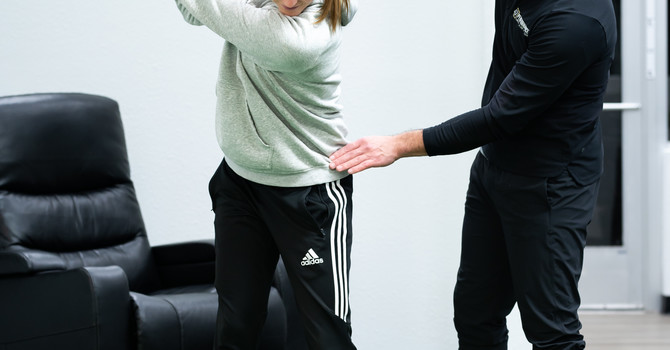
  • Functional movement analysis to see how your back problem affects real-world activities

Our Treatment Approach

We combine soft tissue work with joint mobilization and movement-specific exercise matched to your diagnosis. Generic "core strengthening" doesn't cut it. Your program targets the specific impairments we identify in your assessment. Learn more about our three-phase treatment philosophy.

Treatments That Accelerate Your Recovery

Your corrective exercise program is the foundation. These targeted treatments reduce pain faster and improve tissue healing:

Chiropractic Adjustments

Controlled, specific adjustments restore joint motion and trigger neurological pain-modulating effects. Research supports manipulation for short-term pain relief in acute low back pain. (Rubinstein et al., 2019)

Dry Needling

Thin needles inserted into trigger points release muscle tension, improve blood flow, and reset overactive tissue in the deep spinal stabilizers. Learn more about dry needling. (Liu et al., 2018)

Neurodynamics

When nerve irritation contributes to your symptoms (sciatica, stenosis), specific movements restore healthy nerve mobility and reduce sensitivity.

Frequently Asked Questions

Most people do not need imaging in the first 6 weeks. Studies show 30-50% of pain-free adults have disc bulges on MRI (Brinjikji et al., 2015). These findings often don't explain your pain and can create unnecessary fear.

MRI is indicated when red flags are present (progressive weakness, bladder/bowel changes, cancer history) or when surgery is being considered after conservative care has failed.

Yes. 80-90% of disc herniations recover with conservative treatment. Your body can resorb herniated disc material through natural immune processes. Surgery is typically reserved for progressive neurological deficits or pain that remains severe after 8-12 weeks of quality conservative care. (Atlas et al., 2005)

Yes, and you often must exercise to recover. Bed rest beyond 1-2 days is harmful for back pain recovery (Dahm et al., 2010). Use this guide:

Green (0-3/10 pain): Proceed normally
Yellow (4-5/10, back to baseline in 24hrs): Acceptable; continue
Red (>6/10 or worse next day): Modify and back off

The relationship between posture and pain is weaker than commonly believed. Research shows people with "perfect" posture get back pain, and people with "poor" posture often don't (Slater et al., 2019).

What matters more is postural variability. Your spine craves movement. The best posture is your next posture.

Muscle strains: 2-6 weeks

Disc herniations: 6-12 weeks (severe cases may take 3-6 months)

Facet/SI joint issues: 4-8 weeks

Stenosis: Ongoing management focused on maximizing function

Early intervention significantly improves outcomes. (Fritz et al., 2012)

When to Seek Emergency Care

Most back pain responds to conservative treatment. Seek immediate medical attention for:

  • Sudden loss of bladder or bowel control
  • Numbness in groin/inner thighs (saddle anesthesia)
  • Progressive weakness in both legs
  • Fever with back pain
  • Significant trauma (fall, accident)

Ready to Get Back to What You Love?

Back pain doesn't have to sideline you. Schedule your appointment today!

We specialize in getting active adults back to the activities that matter, without surgery and without fear that your spine is broken.

Schedule Your Evaluation