.jpg)
You know the feeling. You are on the back nine at Highland Springs or Rivercut, having a decent round. You step up to the tee, rip a drive, and immediately reach for your lower back. You finish the round, but getting out of the car at home feels like a wrestling match.
If this sounds familiar, you aren’t alone. Lower back pain is the #1 injury in golf, affecting everyone from weekend warriors to PGA pros.
But here is the truth: Back pain isn't a mandatory price of admission for golfers. It is usually a sign of a specific mechanical breakdown. Below, we break down exactly what is hurting, why it’s happening, and the three steps to fix it right here in the Ozarks.
The Anatomy: What is Actually Hurting?
When you feel that sharp pinch or dull ache, what is actually happening inside your spine? In the medical world, we usually see two main culprits in golfers:
-
Facet Joint Irritation: Your spine has small stabilizing joints on the back of each vertebrae called "facet joints." The golf swing involves massive rotation and extension (arching back). This jams these joints together, causing sharp, pinpoint pain.
-
Disc Issues: The rotation of a swing creates "shear force"—like twisting a wet towel. If your core isn't protecting your spine, this force can irritate the discs between your vertebrae, leading to a deep, central ache or even radiating pain.
Why Golf Hates Your Spine (The Science)
To understand why you hurt, you have to look at the physics. The modern golf swing generates massive torque. You plant your feet, rotate your hips, and then rotate your shoulders even further to create tension (the X-Factor).
Your lumbar spine (lower back) is built for stability, not massive rotation. It only has about 12-15 degrees of rotation total. Here is the problem: When your hips or thoracic spine (upper back) are too stiff—common in office workers—your lower back is forced to rotate more than it physically can.
Result? Shear force and compression.
The Ozarks Factor: Uneven Lies
Here in Southwest Missouri, we don't play flat golf. We play hill golf. When the ball is above or below your feet, your spine angle changes.
-
Ball Above Feet: Forces you to stand taller, flattening your swing.
-
Ball Below Feet: Forces you to bend more, increasing lumbar strain. If you lack the core stability to handle these uneven lies, your back takes the beating.
Symptom Checklist: Is This You?
How do you know if your pain is "normal stiffness" or a mechanical breakdown? Look for these signs:
-
The "Follow-Through" Pinch: Sharp pain on the right side of your lower back (for right-handed golfers) at the finish of your swing.
-
Morning Stiffness: You wake up the day after a round feeling like the Tin Man.
-
Radiating Aches: Pain that travels into the buttock or slightly down the hamstring (often confused for tight hamstrings).
-
Inability to Stand Up Straight: You walk hunched over for the first few steps after sitting.
The Fix: A 3-Step Strategy to Stay on the Course
Rest and Ibuprofen are not a strategy; they are a band-aid. To actually fix the problem, we use a "Mobility-Stability-Load" approach at 417 Performance.
1. Mobilize the "Blockers" (Hips & Upper Back)
If your hips and upper back don't move, your lower back suffers. We need to unlock the segments above and below the pain.
-
Try This: The Open Book Stretch. Lay on your side, knees bent. Rotate your top arm open like a book while keeping your knees glued together. This frees up your thoracic spine so your lower back doesn't have to twist as much.
2. Stabilize the Core (Anti-Rotation)
Most golfers have weak cores. Not "sit-up" weak, but "stability" weak. You need to teach your muscles to brace against the violence of the swing.
-
Try This: The Pallof Press.
-
Stand perpendicular to a cable machine or band.
-
Hold the handle at your chest, step out to create tension.
-
Press hands straight out. Don't let the band twist you.
-
Hold for 3 seconds. Repeat 10x. This mimics the forces of the golf swing and teaches your spine to stay safe.
-
3. Professional Mechanics & Treatment
Sometimes, you can't fix it alone. If you have a joint that is physically "locked" or a muscle that is in spasm, no amount of stretching will release it.
-
Sports Chiropractic Adjustment: We restore motion to the jammed facet joints.
-
Soft Tissue Work: We release the tight Quadratus Lumborum (QL) and Psoas muscles pulling on your spine.
-
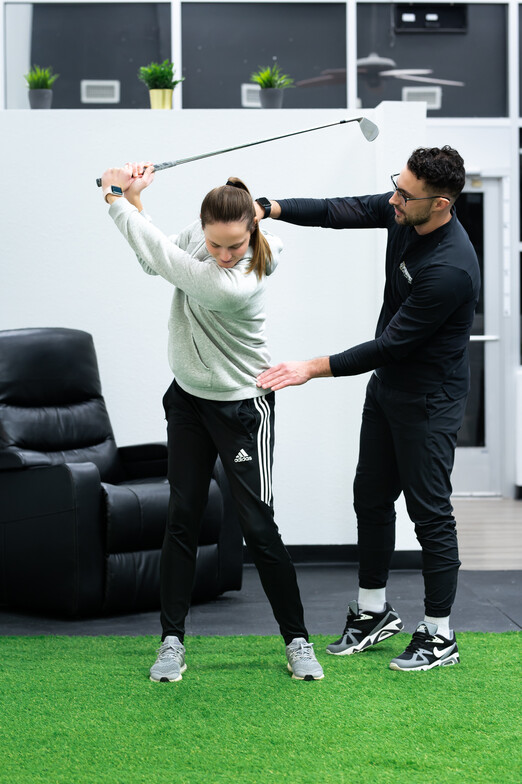
Swing Analysis: We look at your swing to see if you are "Reverse Spining" or "Early Extending"—two major swing faults that cause pain.
Stop Blaming Your Age
You don't have to play in pain, and you certainly don't need surgery just because your back feels stiff after 18 holes. You need a mechanic who understands the demands of the sport.
If you are in Springfield, Nixa, or the surrounding Ozarks, let's take a look at your movement. We can identify exactly where your kinetic chain is breaking down and build a plan to fix it.
Ready to play pain-free? Don't guess with your back. Book your Golf Movement Assessment at 417 Performance today and let's keep you in the fairway.
.jpg)