.jpg)
Let's talk about something that doesn't get nearly enough attention in fitness circles: joint centration. I know that sounds like technical jargon, but stick with me here because this concept explains why some athletes stay healthy for decades while others end up with hip replacements in their 50s.
Joint centration is essentially your body's way of keeping bone surfaces optimally aligned during movement. When a joint is centrated, the contact area between bones is maximized, which means force gets distributed evenly across the cartilage. When it's not? You get focused pressure on small areas, and that's when cartilage starts breaking down faster than it can repair itself.
Think of it like wheel alignment on your car. When your wheels are properly aligned, tires wear evenly and last 50,000 miles. When they're misaligned, you're buying new tires every 10,000 miles because the inside edge is grinding down to nothing. Your joints work the same way.
The Problem Nobody's Talking About at the Gym
Here's where things get interesting: most gym-goers and even many coaches focus almost exclusively on strength and endurance. Can you lift more? Can you run faster? These are reasonable goals. But they completely miss the question of how you're producing that force.
At 417 Performance, we've observed something consistent across hundreds of patients: athletes who can deadlift impressive numbers but can't maintain proper joint position during a simple hip hinge often end up with hip impingement or low back pain within a few years. The strength is there, but the stability architecture underneath it is compromised.
This doesn't mean you should avoid heavy lifting. It means you need to understand what's happening at your joints when you load them.
What Happens When Joints Lose Centration
When a joint decentrates (loses that optimal alignment), a cascade of problems follows:
- Cartilage takes a beating. Instead of spreading force across a large surface area, you concentrate pressure on focal points. This accelerates wear and leads to early-onset arthritis.
- Passive structures become primary stabilizers. Your ligaments and joint capsule start working overtime to stabilize a joint that should be stabilized by muscle coordination. Over time, they stretch out or develop chronic inflammation.
- Muscles get confused about their jobs. Your brain recruits superficial muscles (the ones designed for power production) to do stability work. This creates the chronic tightness and trigger points that feel like they need constant massage or foam rolling, but never actually resolve.
That last point is crucial. When someone tells me their hip flexors are "always tight" or their upper traps won't release no matter how much they stretch, that's usually a stability problem masquerading as a flexibility problem. The muscles are tight because they're desperately trying to stabilize a joint that's not centrated properly.
The Blueprint You Already Have (But Forgot)
Here's the wild part: you already knew how to move with perfect joint centration. You did it as a baby.
The Prague School of Rehabilitation (a group of neurologists and physical therapists who've been studying movement for decades) discovered something remarkable: the movement patterns that develop during infancy aren't learned through imitation. They're hardwired into our nervous system and unfold in a predictable sequence as the brain matures.
Watch a 3-month-old lift their head while lying on their stomach. They're not just building neck strength; they're establishing the first stable relationship between their spine, ribcage, and shoulder blades. By 7 months, babies can rotate over a fixed limb without collapsing, demonstrating hip and shoulder centration that many adult athletes have lost.
That deep squat a 12-month-old does? Heels flat, knees tracking over toes, spine neutral? That's biomechanically flawless. It's what your body is designed to do.
So what happened? Years of sitting. Poor loading patterns. Maybe some injuries that changed how you moved. Your brain didn't forget these patterns exactly; it just stopped having access to them. The motor control community calls this "motor amnesia."
The Core Stability Myth
When most people think about core stability, they picture six-pack abs and planks. But here's what the research actually shows: true core stability comes from a pressurized system, not a muscular brace.
Your diaphragm (yes, the breathing muscle) is actually a critical stabilizer. When it contracts and descends during inhalation, it creates intra-abdominal pressure if the rest of your "canister" (pelvic floor, abdominal wall) responds appropriately. This pressurized cylinder can reduce compressive forces on your spinal discs by up to 50% during heavy lifting.
Studies by researchers like McGill and Stokes have confirmed that this pressure mechanism increases lumbar spine stiffness independent of how strong your muscles are. You can have impressive ab strength and completely dysfunctional core pressure regulation.
The clinical sign we look for at 417 Performance is breathing pattern. If your chest rises significantly before your belly expands during a deep breath, your diaphragm isn't functioning as a stabilizer. If your belly actually draws inward when you inhale (paradoxical breathing), you're essentially loading your spine with a broken foundation.
The "Open Scissors" Problem
One of the most common stability failures we see in Springfield athletes, whether they're training at Proximal Strength, hitting WODs at CrossFit Provision, or just trying to keep up with their running group on the Galloway Creek Greenway, is what's called the "open scissors" posture.
Picture scissors: the ribs are the top blade, the pelvis is the bottom blade. When aligned properly, the diaphragm faces directly down toward the pelvic floor, creating an efficient pressure cylinder. But when someone flares their ribs (arches their back) or tips their pelvis forward, the scissors "open." Now the diaphragm faces forward, the pelvic floor faces backward, and the pressure system can't generate force efficiently.
What happens next is predictable: the brain recruits the back muscles to do the stabilizing work. This is why so many people grip through their low back during squats, deadlifts, or overhead presses. They're compensating for a broken pressure system with muscle tension.
Common Decentration Patterns We See
Neurologist Vladimir Janda identified systematic patterns of muscle dysfunction that map directly to joint decentration. These aren't random imbalances; they're predictable responses to stability failures:
Upper Crossed Syndrome: Weak deep neck flexors and lower traps, overactive upper traps and pecs. The neck hyperextends, shoulder blades wing out, and the shoulder joint translates forward. This is the posture of someone who sits at a computer all day, and it sets up the shoulder for impingement and rotator cuff problems.
Lower Crossed Syndrome: Weak glutes and deep abdominals, overactive hip flexors and low back muscles. The pelvis tips forward, jamming the lumbar facet joints into extension while letting the hip drift anteriorly. This pattern shows up constantly in runners with hip pain and lifters with recurring back injuries.
What's important to understand is that these aren't just muscle tightness problems. Stretching your hip flexors won't fix lower crossed syndrome if the underlying stability deficit remains. Your brain will keep recruiting those muscles for stabilization because it has no other option.
The Shoulder: A Case Study in Centration
The shoulder is basically an engineering compromise: incredible mobility at the cost of inherent instability. The humeral head (ball) is much larger than the glenoid (socket), so stability depends almost entirely on the neuromuscular system positioning everything correctly.
In a centrated shoulder, the ball rotates largely in place within the socket during movement. The instantaneous center of rotation stays constant, and force transfers efficiently from the trunk through the arm.
The most common decentration fault is anterior humeral glide. During movements like bench press or throwing, the pecs and lats pull the ball forward in the socket. If the rotator cuff and scapular stabilizers can't counteract this, the head slides forward, impinging on the biceps tendon and supraspinatus. This is why so many overhead athletes end up with labral tears and rotator cuff problems.
For throwing athletes, there's another layer: the ability to stabilize the shoulder while the opposite side generates and transmits force. This pattern develops around 7 months of age when infants learn to rotate over a fixed limb. An adult pitcher with a decentrated shoulder is essentially missing the motor program that should have been automatic.
Why Your Knee Pain Might Be a Hip Problem
The knee is primarily a hinge joint, which means it's largely at the mercy of what happens above (hip) and below (ankle). Patellofemoral pain syndrome ("runner's knee") is a perfect example of how decentration elsewhere creates problems at the knee.
Here's the mechanism: when the hip decentrates into internal rotation and adduction (usually from weak glute medius), the femur rotates underneath the patella. The kneecap, tethered by the quadriceps tendon, can't follow that rotation, so it ends up tracking laterally relative to the femur. The lateral patellar facet gets ground down, cartilage breaks down, and you end up with anterior knee pain.
This is why VMO strengthening exercises often fail to resolve patellofemoral pain. The VMO isn't the problem; the hip control that prevents femoral rotation is the problem. Training the hip in a centrated position (using patterns from 4-7 month development) addresses the root cause.
We see this pattern constantly in Springfield-area runners who log miles on the South Creek Greenway or the trails at Nathanael Greene Park. Their knees hurt, but the dysfunction is upstream at the hip.
The Squat: Where Everything Comes Together
The squat is a fundamental human movement that appears in the developmental sequence around 12 months. It requires "triple flexion" of hips, knees, and ankles, and it's where most stability deficits become obvious.
For a deep squat, the femoral head needs to glide posteriorly and inferiorly into the acetabulum. This clears space for the femur to flex without jamming into the front of the hip socket. People who lack this posterior glide either can't squat deep, or they compensate by letting their pelvis tuck under (the dreaded "butt wink").
Here's where it gets interesting: the butt wink is usually blamed on tight hamstrings, but that's rarely the actual issue. More often, it's a failure of the Integrated Spinal Stabilizing System. When intra-abdominal pressure is lost at depth, the lumbosacral junction becomes unstable, and the pelvis tucks posteriorly to find stability from ligaments instead of muscles.
Athletes who are "back grippers" (chronically arching their low back) often develop hip impingement because their anterior pelvic tilt positions the acetabulum to cover more of the femoral head anteriorly. When they squat, the femoral neck collides with the acetabular rim before they reach full depth. The solution isn't stretching the hip; it's restoring neutral pelvic alignment through proper pressure regulation.
Self-Assessment: Where Are You Decentrated?
Before diving into corrective exercises, it helps to know where your issues are. Here are three quick assessments:
Breathing Test: Lie on your back with knees bent. Place one hand on your upper chest, one on your lower belly. Take a deep breath. What rises first? In functional breathing, the belly hand rises first and the expansion goes all the way around (front, sides, and pressing into the floor). If your chest rises significantly, or if your belly draws inward, your diaphragm isn't doing its stability job.
Shoulder Centration Test: Lie on your back with your arm out to the side in a "T" position, elbow bent to 90 degrees. Slowly rotate your forearm toward the floor (internal rotation). In a centrated shoulder, the arm rotates smoothly without the shoulder popping forward or the shoulder blade lifting off the ground. If you see anterior translation of the humeral head, you've got stability work to do.
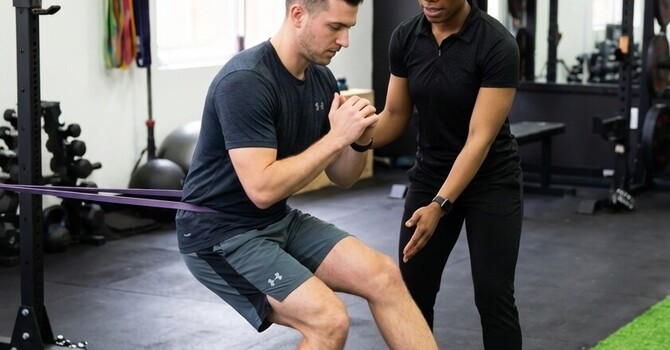
Single-Leg Stance: Stand on one leg in front of a mirror. Watch your pelvis and knee. In a centrated stance, the pelvis stays level and the knee tracks over the second toe. If your hip drops or shoots out to the side (Trendelenburg sign), or if your knee collapses inward, your hip stabilizers aren't doing their job.
Corrective Strategies That Actually Work
The key insight from Dynamic Neuromuscular Stabilization is that you don't fix stability by isolating muscles. You fix it by recreating developmental positions that reflexively activate the stabilizers. Here are the foundational exercises:
90/90 Breathing: Lie on your back with feet on a wall, hips and knees at 90 degrees. This position flattens the low back and tilts the pelvis slightly posteriorly. From here, practice breathing into the lower back and sides while keeping the ribs from flaring. This restores the diaphragm's stabilization function in a supported position.
Dead Bug (3-Month Position): Supine with arms and legs in the air, maintaining a neutral spine. The goal is to keep the pressurized cylinder intact while moving limbs. If your back arches when you extend an arm or leg, you're losing the stability foundation. Scale back to smaller movements until you can maintain position.
Quadruped Rockback: On hands and knees, rock your hips back toward your heels while keeping the spine neutral. "Push the floor away" to keep the shoulder blades engaged. This trains hip flexion with maintained spinal position, addressing the squat dysfunction at its root.
Bear Position: Quadruped position with knees hovering one inch off the floor. This demands massive reflexive stabilization of both the shoulder girdle and core. If you can't hold this position with a flat back and breathing normally, you've identified a significant stability gap.
Side-Lying Hip Lift: Lie on your side with knees bent. Lift your hips by driving the bottom knee into the floor. This mimics the 7-month oblique sitting initiation and trains the hip as a stable pivot point rather than just a power producer.
Coaching Cues That Change Everything
The language you use during exercise matters more than most people realize. Some traditional cues actually reinforce decentration:
Instead of "Squeeze your glutes" (which often leads to posterior pelvic tuck and butt gripping), try "Root your feet and push the floor away."
Instead of "Chest up" (which often causes rib flare and the open scissors position), try "Lengthen your spine" or "Show the logo on your shirt without arching."
Instead of "Pin your shoulders back" (which creates rigid, restrictive movement), try "Reach long" or "Make your back wide." This facilitates scapular wrap and serratus activation rather than just rhomboid clenching.
The Performance Payoff
Beyond injury prevention, joint centration has direct performance benefits. When joints are centrated, muscles operate at their optimal length-tension relationship, generating maximum force. When joints are decentrated, both agonist and antagonist muscles are working from disadvantaged positions.
There's also a neurological component. The central nervous system uses protective mechanisms called "arthrogenic muscle inhibition." When joint receptors detect instability (decentration), the brain reflexively limits how much force the prime movers can generate. It's like a governor on a car engine. Establishing centration signals to the nervous system that the joint is safe, removing those protective brakes and allowing access to higher force production.
This explains why athletes sometimes see immediate strength gains after posture correction. They didn't get stronger; they just got permission from their nervous system to use the strength they already had.
What This Means for Your Training
The concept of joint centration challenges the "no pain, no gain" mentality. True strength isn't just about force production; it's about controlling that force through optimal joint mechanics. An athlete who can deadlift 500 pounds with a decentrated spine is accelerating disc degeneration with every rep. An athlete who can "only" pull 400 pounds with perfect centration is building a body that will still be functional in 30 years.
This doesn't mean avoiding hard training. It means earning the right to train hard by establishing the stability foundation first. The developmental positions that establish centration aren't warmup exercises to rush through; they're the prerequisite for everything else.
When to Seek Professional Help
Self-assessment and corrective exercises can address mild stability deficits, but significant decentration patterns usually require professional evaluation. Signs that you need hands-on assessment include:
- Pain that doesn't resolve with rest or standard treatment
- Mobility restrictions that don't improve with stretching
- Chronic tightness that returns within hours of manual therapy
- Recurring injuries to the same area despite addressing "obvious" problems
- Inability to maintain neutral spine during basic movements despite practice
At 417 Performance, we use Dynamic Neuromuscular Stabilization assessment protocols to identify exactly where the motor control breakdown is occurring. This isn't guesswork; it's a systematic evaluation of how your nervous system is (or isn't) organizing movement. From there, treatment addresses the actual dysfunction rather than chasing symptoms.
The athletes we work with, whether they're training for their first 5K on the Frisco Highline Trail or competing at a regional CrossFit competition, all benefit from understanding where their stability gaps are. Some need intensive rehabilitation of specific patterns. Others just need cueing corrections and a few targeted exercises integrated into their existing training. The assessment tells us which approach is appropriate.
The Bottom Line
Joint centration isn't a luxury reserved for elite athletes. It's a biological prerequisite for musculoskeletal health. Every time you load a decentrated joint, you're trading short-term performance for long-term structural damage. Every time you train with proper centration, you're building a body that gets stronger without accumulating wear.
The research from the Prague School and decades of clinical observation point to the same conclusion: quality of movement determines longevity of joints. In a fitness culture obsessed with quantity (more weight, more miles, more reps), focusing on the quality of centration is the most effective investment you can make in your physical future.
If you're dealing with persistent pain, recurring injuries, or just a sense that something isn't right with how you move, we'd be glad to help you figure out what's going on. Give us a call at (417) 597-3777 or schedule an evaluation online. We'll assess your movement, identify the stability gaps, and build a plan to address them. No gimmicks, no quick fixes, just evidence-based treatment that respects how your body is actually designed to work.
References:
- Koláø P. Clinical Rehabilitation. Prague: Rehabilitation Prague School; 2013.
- Frank C, Kobesova A, Kolar P. Dynamic neuromuscular stabilization & sports rehabilitation. Int J Sports Phys Ther. 2013;8(1):62-73.
- Stokes IA, Gardner-Morse MG, Henry SM. Intra-abdominal pressure and abdominal wall muscular function: Spinal unloading mechanism. Clin Biomech. 2010;25(9):859-866.
- Janda V. Muscles and motor control in low back pain: Assessment and management. In: Twomey LT, ed. Physical Therapy of the Low Back. New York: Churchill Livingstone; 1987:253-278.
.jpg)