.jpg)
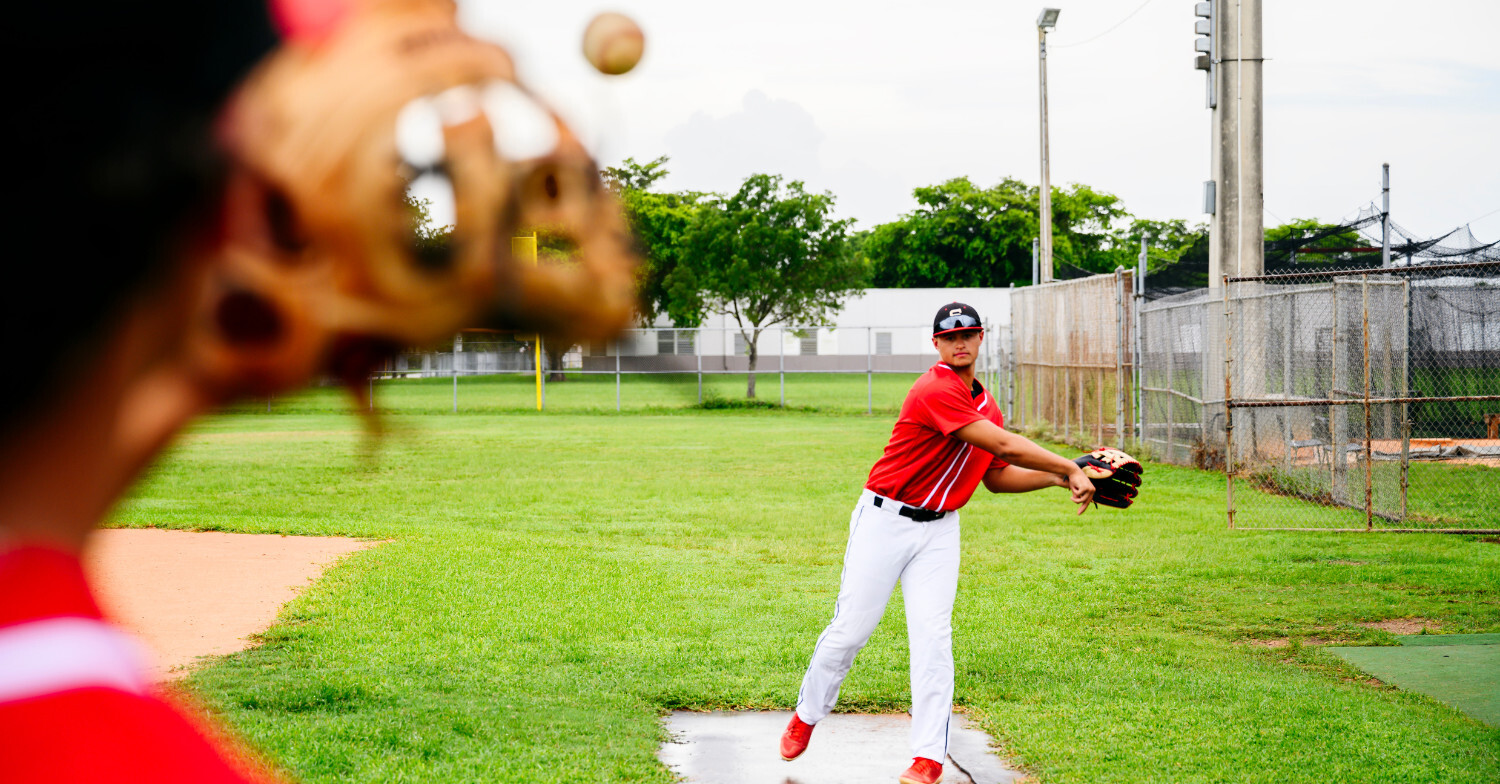
You've watched them do it a hundred times: quick jog, some arm circles, a few stretches against the fence, then they start playing catch. It looks like warming up. But here's what the research actually tells us: that approach may be doing more harm than good.
A well-designed warm-up protocol can cut shoulder and elbow injuries nearly in half. A poorly designed one, or the casual "throw to get loose" approach still common at Meador Park and Killian Softball Complex on Saturday mornings, leaves the arm's stabilizing muscles cold while the shoulder absorbs forces it isn't ready for. The difference between these two scenarios comes down to understanding what a warm-up is actually supposed to accomplish, and most of what we've been taught gets it backwards.
The following breakdown covers why traditional warm-ups fail overhead athletes, what the shoulder actually needs before throwing, and how to structure a routine that protects the arm without adding 45 minutes to your pre-game schedule.
Why "Just Playing Catch to Loosen Up" Is a Problem
Here's the uncomfortable reality: throwing a baseball or softball is one of the most violent movements the human body performs. During the acceleration phase of a pitch, the upper arm rotates at speeds exceeding 7,000 degrees per second. That's not a typo. The forces involved would tear the shoulder apart if it weren't for a finely tuned system of muscles working in millisecond coordination to keep the ball of the humerus centered in the socket.
When an athlete throws with a "cold" shoulder, those stabilizing muscles haven't been neurologically activated. The rotator cuff, which normally fires before the big prime movers to compress and center the joint, is essentially asleep. This forces the passive structures (the labrum, the capsule, the ligaments) to absorb forces they weren't designed to handle repetitively.
One throw won't cause a tear. But multiply that by hundreds of throws per week, weeks per season, seasons per career. The microtrauma accumulates quietly until a parent notices their kid rubbing their shoulder after practice, or a rec league player realizes they can't throw from the outfield without their arm going dead by the fifth inning.
What we see at 417 Performance is athletes who "did everything right" but still end up with shoulder instability or elbow problems. When we dig into their history, the warm-up almost always comes up. They were doing something before throwing. It just wasn't the right something.
What the Shoulder Actually Needs (And Doesn't Need) Before Throwing
There's a concept in sports medicine called the "thrower's paradox." The shoulder needs to be loose enough to achieve extreme ranges of motion during the cocking phase (often exceeding 100 degrees of external rotation), while simultaneously being stable enough to prevent the ball from sliding forward out of the socket during acceleration and deceleration. These seem like contradictory demands, and they are. The solution isn't to stretch everything until it's maximally loose. It's to activate the dynamic stabilizers so they can control motion through that range.
This is where static stretching before throwing becomes problematic.
Research published in the Journal of Strength and Conditioning Research shows that static stretching before power activities can reduce muscle activation and inhibit the stretch-shortening cycle that throwing depends on. Think of it this way: you're temporarily making the muscles "sleepy" right before asking them to perform at maximum output. Dynamic movement, on the other hand, primes the nervous system without creating that inhibitory effect.
This doesn't mean stretching has no place. It does, but post-activity is when static stretching provides its benefit by restoring resting muscle length. Pre-activity, dynamic preparation is what prepares tissue for explosive movement.
The Components of an Effective Throwing Warm-Up
A proper pre-throwing routine accomplishes four things in sequence: it raises core body temperature, activates the stabilizing muscles of the shoulder blade and rotator cuff, mobilizes the thoracic spine and hips, and integrates the entire kinetic chain from ground to fingertips.
Core Temperature and Blood Flow
This is the part most athletes get partially right. Light jogging, jumping jacks, or dynamic footwork drills elevate heart rate and increase blood flow to muscles. What matters here is duration. Two minutes of arm circles isn't enough. Five to seven minutes of general movement that produces a light sweat creates the tissue temperature changes necessary for the next phases to work.
Scapular Activation
Here's where most warm-ups fall short. The shoulder blade (scapula) is the base of support for the entire arm. When it doesn't move in coordination with the arm, the rotator cuff gets put in mechanically disadvantaged positions. Studies on overhead athletes show that scapular dyskinesis (abnormal shoulder blade movement) significantly affects shoulder proprioception, meaning the athlete's ability to sense where their arm is in space becomes impaired.
Key Scapular Activation Exercises
Wall slides: Stand with forearms against a wall, elbows at 90 degrees. Slide the arms up into a Y shape while keeping the shoulder blades wrapped around the ribcage. This trains the serratus anterior and lower trapezius to control upward rotation.
Bear crawl position holds: Hands under shoulders, knees under hips, toes tucked, knees hovering one inch off the ground. Press hands into the floor to spread the shoulder blades. Hold for 20 to 30 seconds. This is a closed-chain position that reflexively fires the rotator cuff and scapular stabilizers together.
Rotator Cuff Activation
The rotator cuff muscles, particularly the infraspinatus and teres minor on the back of the shoulder, serve as the "brakes" for the arm. During deceleration, they eccentrically contract against forces roughly equal to body weight to stop the arm from flying off. If they're not neurologically "on" before throwing starts, the capsule and labrum take the hit.
Banded external rotation at various angles (elbow at the side, elbow at 90 degrees of abduction) activates these muscles without fatiguing them. The goal is activation, not exhaustion. Light resistance, controlled movement, 10 to 15 repetitions per position.
Thoracic Spine and Hip Mobility
This is the piece that separates a good warm-up from a complete one. Research on collegiate pitchers shows a moderate positive relationship between upper quarter dynamic stability and throwing performance scores. What does upper quarter stability depend on? Adequate mobility in the thoracic spine and hips.
If the mid-back is stiff, the shoulder compensates by creating extra motion at the glenohumeral joint. That hypermobility might allow the athlete to hit their arm slot, but it comes at the cost of anterior shoulder stress. Similarly, restricted hip rotation forces the trunk to rotate less, which means more energy must be generated by the arm rather than transferred through it.
Over 50% of the energy delivered to a thrown ball originates from the lower body and core. The shoulder acts more like a funnel and regulator than a generator. When the hips and trunk can't do their job, the arm picks up the slack. This "catch-up" phenomenon dramatically increases stress on the shoulder and elbow.
Quadruped thoracic rotation (one hand behind the head, rotating the elbow toward the opposite wrist then up toward the ceiling), 90/90 hip switches, and walking lunges with rotation address these mobility needs without static holds that might inhibit power output.
What the Research Shows About Prevention Programs
A randomized controlled trial published in the American Journal of Sports Medicine followed 237 youth baseball players over 12 months. Half performed a structured warm-up protocol including dynamic mobility and balance training. The other half continued their normal routines. The intervention group experienced shoulder and elbow injuries at nearly half the rate of the control group. The prevention program also improved pitching velocity, likely because the improved movement efficiency allowed more force transfer from legs to arm.
A scoping review in the Journal of Shoulder and Elbow Surgery confirmed that programs incorporating sleeper stretching (for the posterior shoulder), external rotation strengthening, and comprehensive movement preparation each show potential to reduce throwing injuries. Importantly, two studies in the review noted that compliance mattered: athletes who actually performed the protocols consistently saw the greatest benefit.
A perfect warm-up protocol that athletes won't actually do is worthless. The most effective approach balances thoroughness with practicality. For youth players especially, building the routine into team culture (rather than expecting individuals to show up early on their own) dramatically improves adherence.
Adapting the Warm-Up to Conditions
A protocol that works perfectly on a 75-degree evening in May needs modification for a February weekend tournament or an 8 AM Sunday morning game.
Cold weather increases tissue viscosity and slows nerve conduction. The warm-up needs to be longer (add 5 to 10 minutes), athletes should keep layers on until fully warm, and continuous movement matters more than ever. Standing around between drills negates the temperature benefit you've built.
Early morning presents different challenges. Body temperature is at its lowest point of the day, spinal discs are more hydrated (and therefore stiffer), and reaction times are slower. Extending the ground-based mobility work, being gentle with early spinal rotation, and including reactive drills at the end to wake up the nervous system all help compensate.
The Time-Crunched Version
Tournament schedules and relief pitcher situations don't always allow for a full 15 to 20 minute routine. When time is limited, prioritize the highest-yield elements:
The 6-Minute Essential Protocol
General heat (1 min): Jumping jacks or seal claps to quickly raise heart rate.
Dynamic shoulder mobility (1 min): Arm circles progressing to arm hugs and swings.
Integrated movement (1 min): Forward lunges with thoracic rotation.
Posterior cuff activation (1 min): Band pull-aparts and face pulls.
Scapular stability (1 min): Bear crawl forward and backward, 10 yards each direction.
Neural wake-up (1 min): Quick pogos or jumping to activate the central nervous system.
Even in a rush, the band work for the posterior cuff should not be skipped. Those muscles are the brake system for the arm. Throwing without activating them is like driving a car with questionable brakes: it might be fine, until it isn't.
When Warm-Up Isn't Enough
A well-structured warm-up reduces injury risk significantly, but it doesn't eliminate it. Cumulative throwing volume, poor mechanics, inadequate recovery, and underlying mobility restrictions all contribute to shoulder and elbow problems independently of preparation quality.
Prospective research on high school baseball pitchers found that 37% reported shoulder symptoms and 37% reported elbow symptoms over a two-season period, with lower back complaints nearly as common. These numbers highlight that throwing sports carry inherent risk even when athletes are doing the right things.
When symptoms persist despite proper preparation, that's a signal to have the kinetic chain evaluated more thoroughly. Often, what presents as shoulder instability or anterior shoulder pain actually originates from hip restrictions, thoracic stiffness, or scapular control deficits that warm-up alone cannot fully address.
If your athlete is dealing with arm symptoms that aren't resolving, or you want a full kinetic chain evaluation to catch problems before they become injuries, schedule an assessment at 417 Performance.
Schedule an Evaluation | Call us at (417) 597-3777
The Bottom Line for Parents, Coaches, and Adult Athletes
The way most teams warm up before throwing doesn't match what the research tells us actually protects the arm. "Playing catch to loosen up" subjects cold tissue to ballistic stress. Static stretching before throwing can temporarily inhibit the muscles needed for stability and power. And arm circles, while not harmful, don't accomplish the scapular activation and kinetic chain integration that overhead throwing demands.
An effective throwing warm-up takes 15 to 20 minutes and follows a logical sequence: general heat, scapular and rotator cuff activation, thoracic and hip mobility, then sport-specific movement. When time is limited, a 6-minute prioritized version can cover the essentials. When conditions are cold or early morning, the protocol needs to be extended and adjusted.
Will changing warm-up protocols guarantee injury prevention? No. Throwing is inherently stressful, and injuries happen even to athletes who do everything right. But the evidence is clear that proper preparation reduces risk substantially. That's a return on investment that makes the extra 10 minutes worthwhile, whether you're coaching 12-year-olds at Allison Sports Town Star, playing adult rec softball at Meador Park, or trying to preserve your arm through a college season.
Sources
Sakata J, Nakamura E, Suzuki T, et al. Throwing Injuries in Youth Baseball Players: Can a Prevention Program Help? A Randomized Controlled Trial. Am J Sports Med. 2019;47(11):2709-2716. Full text
Karasuyama M, Tsuruta T, Kawakami J, et al. Preventive interventions for throwing injuries in baseball players: a scoping review. J Shoulder Elbow Surg. 2024;33(8):e451-e458. Full text
Reyhani F, Meftahi N, Rojhani-Shirazi Z. Comparing shoulder proprioception, upper extremity dynamic stability, and hand grip strength in overhead athletes with and without scapular dyskinesis. J Bodyw Mov Ther. 2024;39:304-310. Full text
Leenen AJR, Hoozemans MJM, van Dis F, et al. Shoulder and Elbow Symptoms in Dutch High School Baseball Pitchers: Results of a Two-Season Prospective Study. J Athl Train. 2024;59(11):1118-1125. Full text
Chasse P, Bullock GS, Schmitt AC, et al. The Relationship Between Trunk Rotation, Upper Quarter Dynamic Stability, and the KJOC Overhead Athlete Score in Division I Collegiate Pitchers. Int J Sports Phys Ther. 2018;13(5):819-827.
.jpg)